
In road tunnels, emergency ventilation isn’t only about managing smoke inside the main tunnel tubes. Cross passages and bypasses are also essential elements of the overall safety strategy, because they provide protected escape routes for tunnel users and safer access for emergency services.
To perform this function effectively, a bypass must remain as protected as possible from smoke and hot gases. A dedicated ventilation system helps achieve this by maintaining the bypass at a slightly higher pressure than the tunnel tube affected by the fire.
Why bypass pressurisation is important
During a tunnel fire, smoke can spread towards adjacent areas through openings, doors and connecting passages. When a bypass connects two tunnel tubes, smoke from the affected tube could enter the escape route, particularly when an emergency door is opened.
A dedicated ventilation system creates a controlled positive pressure inside the bypass. This pressure difference helps oppose smoke infiltration and supports safer conditions along the evacuation route. The operating principle is simple: fresh air is supplied to the bypass so that its internal pressure remains slightly higher than the pressure inside the smoke-affected tunnel.
At the same time, that pressure has to remain carefully controlled. If it becomes too high, emergency doors could become difficult to open, which would reduce the effectiveness of the escape route itself.
The role of the ventilation fan
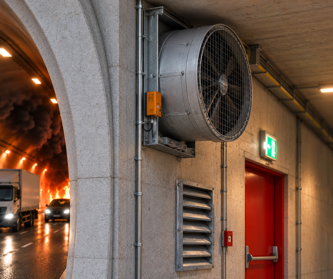
The fan is the main component responsible for supplying fresh air and maintaining the required pressure inside the bypass.
Depending on the tunnel layout and project requirements, it can be installed inside or close to the connecting passage and integrated into a dedicated ventilation duct.
During an emergency, the fan supplies air to the bypass and creates the pressure difference needed to reduce the risk of smoke entering from the affected tunnel tube. For this reason, fan selection cannot be based only on airflow. The required pressure conditions and the behaviour of the complete system during an emergency must also be considered.
Controlling pressure with an overpressure damper
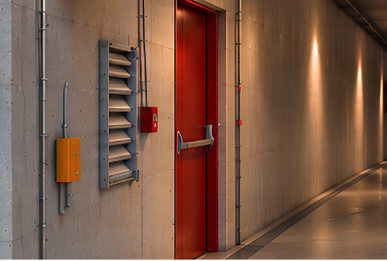
Maintaining positive pressure doesn’t mean supplying as much air as possible. The system must generate enough pressure to help prevent smoke infiltration, while still allowing users and emergency personnel to open the doors without excessive effort.
This is where the overpressure damper becomes essential.
When the preset pressure level is reached, the damper opens automatically and releases part of the excess air. In this way, the system can maintain more stable and controlled pressure conditions inside the bypass.
The ventilation system therefore has to balance two key requirements:
- preventing or limiting smoke infiltration into the bypass;
- keeping emergency doors accessible and easy to operate.
The function of the fire damper
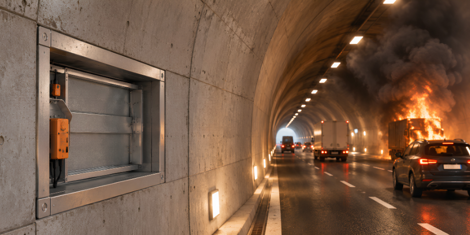
Another important safety component is the fire damper installed directly on the fan inlet.
During normal emergency operation, the ventilation system supplies fresh air to the bypass. However, if fire or smoke conditions require the ventilation path to be isolated from the affected tunnel, the fire damper can close automatically. Its purpose is to help prevent flames, hot gases and smoke from propagating through the ventilation system.
The fan, overpressure damper and fire damper therefore work together as part of an integrated system designed to maintain the bypass as a protected area during an emergency.
Bypass ventilation as part of the complete tunnel safety strategy
Bypass ventilation should always be considered together with the overall tunnel ventilation and fire-safety concept.
Its performance depends on several project-specific factors, including tunnel geometry, pressure differences between the two tubes, door characteristics, leakage areas and the ventilation conditions generated inside the tunnel during a fire.
This is why the fan and the associated control components must be selected according to the actual characteristics of each installation.
At CBI Group, tunnel ventilation solutions can be engineered according to specific project requirements, integrating fans, dampers and dedicated ventilation components for both normal operating conditions and emergency scenarios.
The objective is to maintain protected escape routes, support evacuation and provide safer access for emergency services when they are needed most.