Industrial fan components: why understanding the parts matters
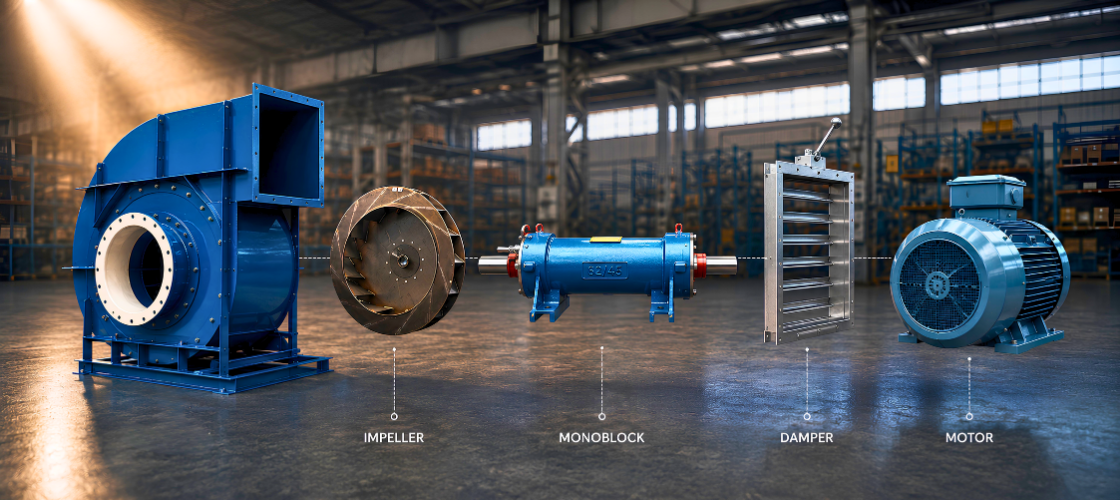
Industrial CBI fans are engineered as long-term assets, designed for continuous operation over decades even in demanding industrial environments, and supported by a predictive maintenance approach. In this context, the immediate availability of the correct spare parts, whether for CBI fans or units from other manufacturers, is essential to ensure operational continuity and minimize downtime, even in the unlikely event of a component failure.
Understanding industrial fan components is therefore not only a technical matter, but a strategic one. Every intervention, whether corrective or preventive, depends on knowing which parts are subject to wear, how they interact, and how they can be replaced without altering the original fan configuration. A component-level approach helps reduce downtime, preserve safety, and restore the fan’s original performance over time.
In this article, we will discuss:
What are the main industrial fan parts?
From a spare parts and service perspective, industrial fans comprise a series of critical components that must match the original design precisely to ensure compatibility and performance. Understanding their roles and interactions is fundamental for efficient maintenance, minimising downtime, and restoring optimal airflow and pressure.
- Monoblock: integrated monoblock designs built for long-lasting resilience and consistent high performance;
- Impeller: high-efficiency impellers engineered for superior airflow optimization and peak performance;
- Shaft with supports: robust shaft assemblies featuring bearings for seamless rotation and minimized wear over time;
- Flow regulators: precision flow regulators enabling exact air volume adjustment and enhanced system efficiency;
- Dampers: advanced dampers designed for precise airflow adjustment, optimal modulation, and reliable system safety;
- Silencers: specialized silencers crafted to minimize noise emissions without compromising airflow performance;
- Isolators: effective vibration isolators that dampen shocks and safeguard fan components from damage;
- Flexible connection: adaptable flexible couplings built to absorb mechanical stresses and promote steady, reliable operation;
- Inlet cone: streamlined inlet cones refined to enhance air intake flow and boost overall system efficiency.
Accurate spare parts replacement requires strict dimensional control, appropriate material selection and full compatibility with the original fan architecture. Even minor deviations can lead to increased vibration, reduced efficiency and accelerated wear.
Contact us for more information!
How does an industrial fan work?
In centrifugal fans, air enters through the inlet, gets accelerated by the impeller's blades, and is then collected by the casing to convert kinetic energy into static pressure at the outlet. In axial fans, air flows parallel to the shaft, propelled straight through by the rotating blades for high-volume, low-pressure applications.
This operating principle means that every rotating and structural component contributes to overall performance. When parts such as bearings, impellers or transmission elements wear over time, the fan gradually moves away from its original operating conditions, often resulting in increased vibrations and abnormal noise levels. These phenomena are early indicators of mechanical imbalance or aerodynamic inefficiencies that, if neglected, can accelerate component fatigue and lead to unexpected downtime. Correct spare parts replacement restores the mechanical and aerodynamic balance of the fan, preventing secondary damage and avoiding unnecessary changes to the surrounding plant.
Fan material and construction: durability and corrosion resistance
From a spare parts perspective, material compatibility is just as important as geometry. Using inappropriate materials can significantly shorten component lifespan and compromise fan safety.
Industrial fan spare parts can be manufactured using:
-
Plastic materials such as polypropylene (PP) and PVDF, particularly suitable for chemically aggressive or acidic fluids;
-
Carbon or mild steel for standard industrial environments;
-
Stainless steel (AISI) or hot dip galvanisation;
-
Components protected with special coatings or fluoropolymer linings (e.g. ECTFE), applied to parts in direct contact with the process fluid.
Matching original materials and construction methods ensures consistent performance and long-term resistance to corrosion, temperature and chemical attack.
CBI approach: spare parts, support, and services for industrial fans
CBI's Spares & Service Division places spare parts at the center of its industrial fan lifecycle strategy. Thanks to a comprehensive technical database and advanced engineering capabilities, CBI is able to supply original or perfectly interchangeable spare parts for industrial fans of different brands and generations.
When original drawings or documentation are unavailable, CBI uses reverse engineering and 3D scanning technologies to accurately reproduce components such as impellers, shafts, housings and monoblocks, ensuring full dimensional and functional compatibility. Where required, technical updates can be introduced to improve reliability and performance.
Immediate spare parts availability, combined with technical expertise developed through installation, maintenance, revamping and diagnostic services, allows CBI to minimize downtime and guarantee continuity of operation. This integrated approach ensures that industrial fans can safely operate at their intended performance levels throughout their entire service life.
Discover CBI’s Spare Parts & Service Division!